Support
A warm, attuned place to help resolve the patterns that keep anxiety, burnout, and self-criticism on repeat.

Sound familiar? Minor annoyances can cause outsized reactions. Your inner critic is relentless. You keep saying "yes," even when your plate is maxed out. And even the "enjoyable" moments don't quite land.
I help adults shift self-limiting patterns of thinking, feeling, and behaving — patterns that can show up as anxiety, burnout, perfectionism, procrastination, or difficulty in relationships.
If you've struggled, unsuccessfully, to change these patterns through insight alone, or by simply "willing" yourself to change, you're not broken. It's likely biology.
Children raised in less-than-ideal — or even frightening — home environments find brilliant ways to make life feel safer: performing "perfectly," staying hypervigilant, or learning exactly what keeps the peace. These strategies let them get on with the business of growing up.
These strategies got wired into the nervous system through repetition, so they now feel like second nature. They aren't.
Trauma-informed therapy aims to unwind old adaptive strategies, and heal the imprint of an ill-fitting, or traumatic, childhood — creating more flexibility, clarity, and ease.
What I treat
You may recognize yourself in more than one of these.
For people who appear composed, or even thriving, while actually feeling depleted, flat, anxious, resentful, or disconnected from themselves or others.
Learn moreTherapy for chronic anxiety, sudden emotional and/or physical overwhelm, chronic hypervigilance or braced for a possible threat — when there is none.
Learn moreSupport for high-achievers who, despite evidence to the contrary, believe they'll be unmasked as incompetent, chase impossible standards, or are rarely satisfied with their performance — even after success.
Learn moreTherapy for procrastination patterns that often trace back to pressure, fear of failure, or harsh self-evaluation — not laziness or poor time management.
Learn moreSupport for difficulty saying no, trouble asking for your own needs to be met, and codependency — behaving in ways that chronically work against your best interests in order to maintain the relationship.
Learn moreWorking with the imprint of relational trauma — usually from the chronic stress of being stuck growing up in a household that was neglectful, unpredictable, harsh, and/or scary. The effects can include hypervigilance, flashbacks, great difficulty trusting others, and uncontrollable activation of animal defenses (fight, flight, freeze, or submit). Anxiety and depression are also common symptoms.
Learn more
I provide therapy online for adults located in California. I also offer Ketamine-Assisted Psychotherapy in person.
A warm, attuned place to help resolve the patterns that keep anxiety, burnout, and self-criticism on repeat.
Collaborative therapy that helps you reconnect with inner wisdom and emotional resilience, for more choice in daily life.
Deeper change at the nervous-system level, not just insight into where the patterns began.
How I treat
I integrate somatic therapy, Attachment-Focused EMDR, parts work, Ketamine-Assisted Psychotherapy, and the Flash Technique when clinically appropriate.
Works from the bottom up, using guided, focused awareness to ease anxiety, update limiting beliefs, and release trauma held in the body.
Learn moreReprocesses disturbing memories so they feel more neutral, resolving distorted beliefs — like "I'm not worthy" — and healing the roots of trauma or self-sabotage. It also taps into your inner healing intelligence to help understand and resolve current issues, and to update new beliefs and behaviors going forward.
Learn moreTIST, akin to IFS, sees reactive patterns as younger "parts" that take over thoughts, behaviors, and the body — usually protectors guarding more vulnerable parts, sometimes working together, sometimes in conflict. The goal: notice, befriend, and help those parts realize you can take care of things now, so they rarely need to.
Learn moreGently surfaces a trauma memory, then pairs it with a strongly positive one — using tapping and eye movements to rewire how the brain classifies the threat.
Learn more
In-person KAP
Not just symptom relief. The focus is root-level change of the beliefs and behavior patterns that keep you stuck.
Ketamine, an FDA-approved medicine, softens difficult memories and opens a 48–72 hour window of neuroplasticity, where new perspectives and self-compassion can take root.
Learn moreDosages vary depending on your doctor's recommendations, your needs, and goals. But we always start with low-dose sessions.
Learn morePreparation, medicine sessions, integration therapy, and specialized approaches support the change you have begun.
Learn moreApproach
I see therapy as a collaborative, attuned space where you can access your own inner wisdom and natural drive to heal.
Real change happens within the trust, safety, and curiosity built between us as therapist and client.
Sessions may include mindful, focused awareness of present-moment experience — thoughts, somatic experience, emotions, images, and memories — to help shift biologically ingrained patterns.
When deeper material is part of the picture, we move at a pace you and your nervous system are ready for. Change is invited. Not forced.
About me
I believe people deserve to feel good and fully alive — and, of course, to play. I have the tools to potentially help make that possible.
I also know personally the value of therapy — it helped me overcome the impact of my own challenging childhood and build a life in service to others.
I'm continually inspired by the resilience, courage, and creativity my clients tap into as they heal. When appropriate, I bring lightness and playfulness into the work itself — healing doesn't have to be all heaviness.
Virtual therapy in California | she/her/hers
Learn More About Me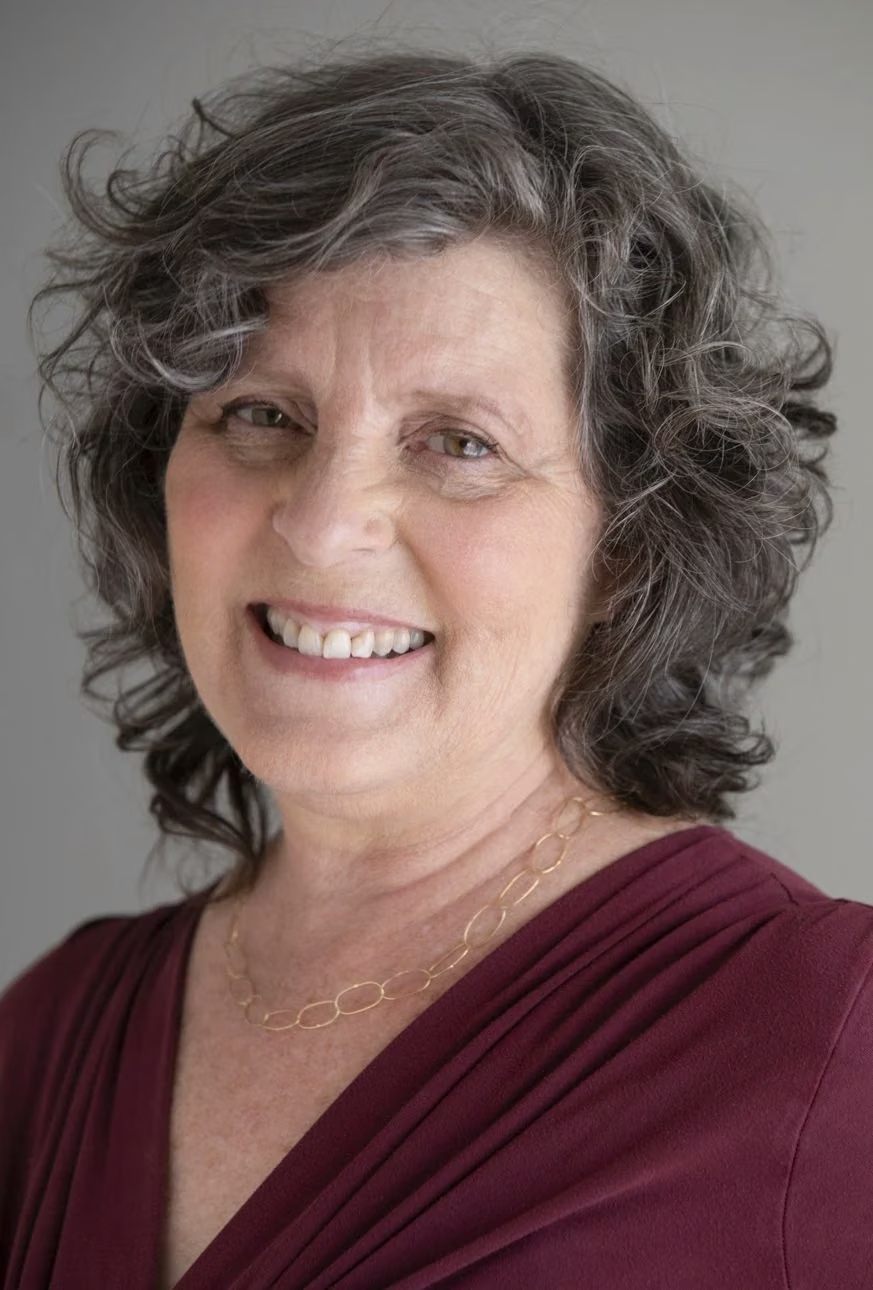
Client testimonials
Joanne is an incredible therapist. I am continually grateful to have her in my life. She has helped me develop into myself in a way I didn't know was possible. Thanks to her support and deep presence, I've been able to find my voice and exercise it in both personal and professional settings. This has meant that I have more agency in these spaces, and have experienced much more genuine connection with others. Joanne gives space for you to process, and also to integrate those learnings, which means that the insights I've gained are profound, and I'm better able to genuinely act from those insights.Agency and connectionC.O.
Joanne is an incredible therapist and a gifted healer. The work we've done together has helped re-wire my nervous system to move beyond repetitive triggers and feel more at home in my body. I can literally feel my brain working differently! It's been amazing and I am incredibly grateful for her guidance. She uses progressive methods like EMDR and sensorimotor to bypass the stories and gently release the core traumatic events of the wounded / adaptive child responses. It's incredible. If you're ready to go beyond talk therapy and transform your life, I cannot recommend her highly enough.Nervous-system healingN.P.
I have had the privilege of working with Joanne over the past 4 years and have found her to be an incredible facilitator of personal growth for me. Her kindness, compassion, and intuition always put me at ease and create a natural flow for us to explore a range of issues. Joanne uses a variety of tools in her practice and always takes care to talk me through them and answer any questions I have. I have seen the benefits of working with Joanne in both my personal and professional life and am extremely grateful for her patience and overall support. I always look forward to our sessions and couldn't recommend her more highly.Personal growthI.W.
Service areas
I provide therapy online for adults located in California. I also offer Ketamine-Assisted Psychotherapy in person.
Contact
I offer a free 20-minute consultation so we can talk about what brings you here, what you're hoping might change, and whether working together feels like a good fit.
Please send me a message below, or feel free to call or text with any questions.